
Online vs Offline Chess Classes: Which Is Better for Your Child?
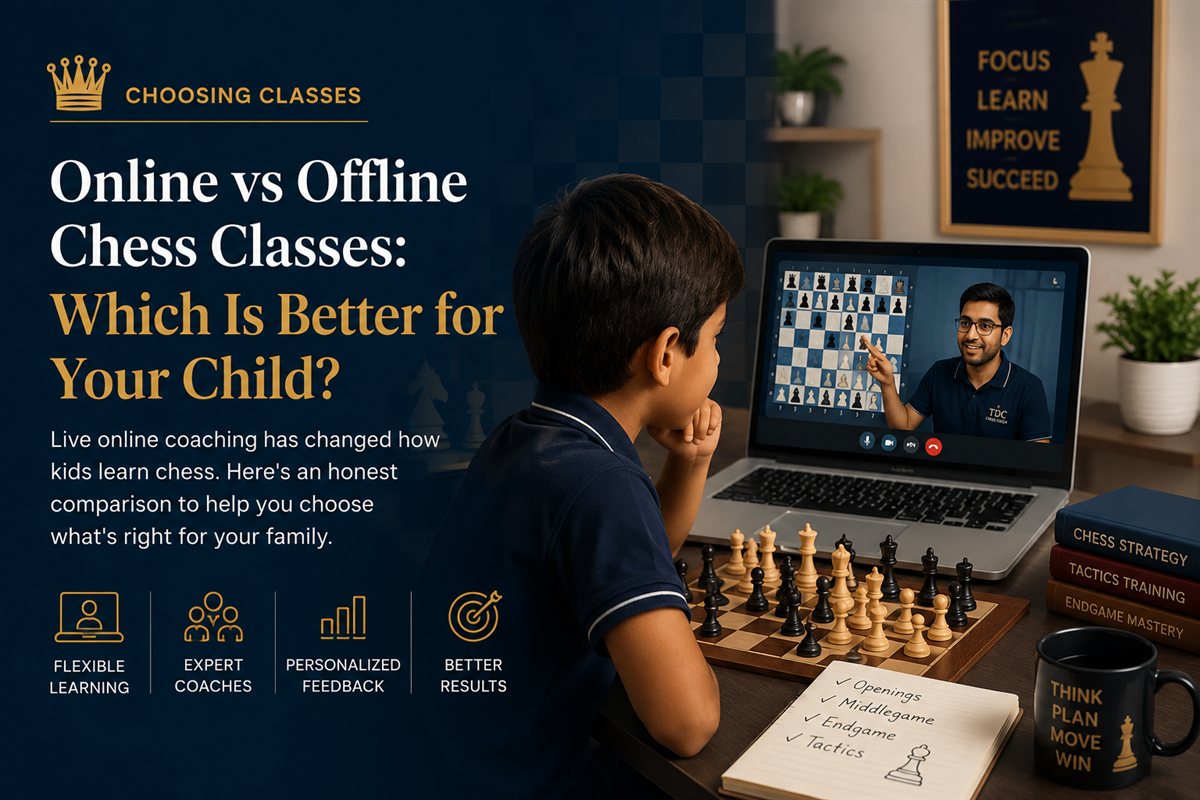
A decade ago, learning chess meant finding a local club. Today, live online coaching has made world-class teaching available from your living room. So which is better — online or offline chess classes? Here's an honest, side-by-side look.
Convenience and time
Online wins comfortably. There's no travel, no traffic, and classes fit neatly around school and family life. For busy families — and for students in cities or towns without a strong local club — online removes the biggest barrier to consistent practice.
Access to the best coaches
Offline, you're limited to coaches near you. Online opens the whole world. Your child can learn from certified, FIDE-rated coaches regardless of where you live — which is especially valuable for serious or advanced students.
Personal attention
This one is about class size, not the medium. A crowded offline class can offer less attention than a small online group. We keep our group classes to 6–7 students, and also offer fully personalised private 1-on-1 coaching — so attention stays high either way.
Tools and practice
Online has a real edge here. Interactive digital boards, instant puzzles, game analysis, and recordings to revisit lessons all make learning faster. Homework and progress tracking are built in, so parents can actually see the improvement.
Social experience and tournaments
Offline clubs offer in-person friendships, and that matters. The good news is that quality online academies recreate this with live group classes, weekly tournaments, and community events — children compete, make friends, and celebrate wins together, just on a screen.
Cost
Online is often more affordable — there's no venue cost, and flexible group or private options let you choose what fits your budget. You can compare simple, transparent plans on our pricing page.
The best class isn't online or offline — it's the one your child attends consistently, with a great coach.
So, which should you choose?
For most families today, live online classes offer the best mix of convenience, coaching quality, and value — provided the academy keeps class sizes small and the curriculum structured. If your child thrives on in-person energy and you have an excellent local club, offline can be wonderful too. Many families even combine both.
Not sure? The easiest way to decide is to try a class. Read more about the best age to start, or see the benefits chess brings to children.
Which suits which child?
| Your child... | Online | Offline |
|---|---|---|
| Is comfortable with screens and independent | Great fit | Fine |
| Needs a lot of physical activity and social play | Pair with sport or clubs | Good for the social side |
| Lives far from strong coaches | Excellent | Limited by travel |
| Is shy | Often feels safer at first | May feel more intimidating at first |
| Is very young (3 to 5) | Works with an adult nearby and short sessions | Works with a patient teacher in person |
Myths about online chess classes
- "Children will not pay attention." With small groups, interactive boards and a good coach, most children are very engaged.
- "You need a real board to learn." It helps, but is not essential. See chess equipment for kids.
- "Online classes are less serious." Quality depends on the coach and curriculum, not the venue. Read who teaches your child's class.
- "Online is only for beginners." Many tournament players train online with strong coaches.
The hybrid approach
Many families combine both: live online coaching for structured learning, and in-person play at school, clubs and tournaments for the social side. That often delivers the best results for the lowest cost in time. See how tournaments work.
Setting up for online success
- A quiet corner, a stable connection and a decent screen.
- Headphones for clearer audio.
- A snack and water before class.
- A parent nearby for younger children.
Read online chess safety for kids and try a free class to see how it feels: what to expect in your first demo.
Frequently asked questions
Are online chess classes as effective as in-person ones?
For most children, yes, when the coach is qualified and the group is small. Online adds flexibility and coach choice; in-person adds social time.
Can young children learn chess online?
Yes, with short playful sessions and an adult nearby for the first classes.
Explore The Digital Chessboard Academy
- Courses: Beginner Explorer to Champion Track
- Pricing and plans
- Meet our coaches
- The Parent Portal
- Free FIDE rating calculator
- Chess learning options compared
- Online chess academies compared
- All chess articles
Try a live online class — free
Experience our small-group, interactive coaching first-hand with a no-obligation demo.